

BY MATT DAUS
Business travel requires a seamless network of airlines, airports, hotels, meetings, and safe and reliable ground transportation connecting every stage of the journey. As our transportation ecosystem undergoes one of its most significant periods of change, the policies governing that network are becoming increasingly important for all involved.
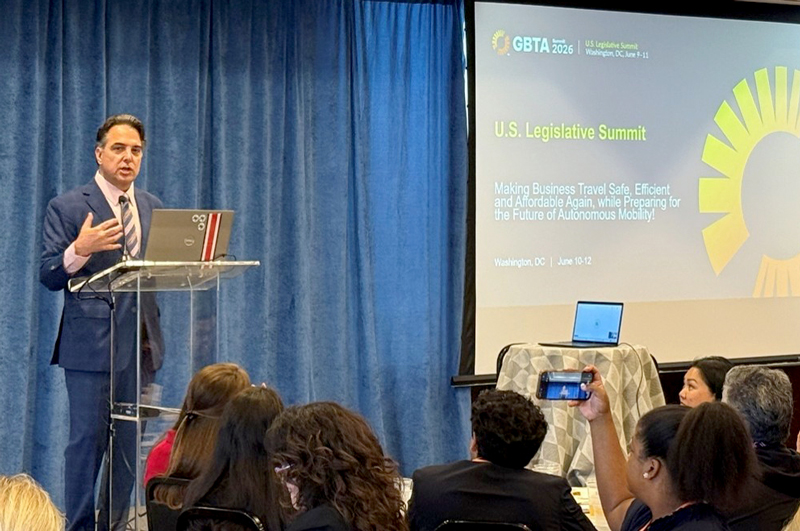 Matt Daus speaking at the GBTA Legislative Summit I recently had the privilege of delivering the keynote address at the Global Business Travel Association (GBTA) Legislative Summit in Washington, D.C. A centerpiece of the event was GBTA’s annual Day on the Hill, where more than 120 members from 31 states met directly with members of Congress and their staffs to advocate for policies supporting an industry that generates an estimated $624 billion in annual economic activity, contributes 2.1% of U.S. GDP, supports 6.7 million American jobs, and produces nearly $149 billion in tax revenue. Armed with findings from GBTA’s latest U.S. Economic Impact Study: Business Travel’s Impact on Jobs and the U.S. Economy, attendees emphasized the critical role business travel plays in connecting communities, driving investment, and strengthening the national economy.
Members of the ground transportation industry presented and participated in GBTA’s Day on the Hill, including Matt Assolin of RMA Worldwide and co-chair of the National Limousine Association’s (NLA) Legislative Committee and Merlynda Bissoon of Key Transportation and president-elect of the GBTA South Florida Chapter. Under the leadership of NLA President Brett Barenholtz of Above All/Maine Limousine, there is now extensive support and coordination with GBTA on legislative and policy issues, which benefits both groups in a wide variety of ways including aligned messages, additional resources, and strength in numbers for our common causes.
As a keynote speaker, I was pleased to add to those discussions by focusing on an equally important component of every business trip: ground transportation. I touched on challenges from skyrocketing commercial insurance costs and illegal transportation operators to airport modernization and autonomous mobility. These are some of my general impressions of the event.
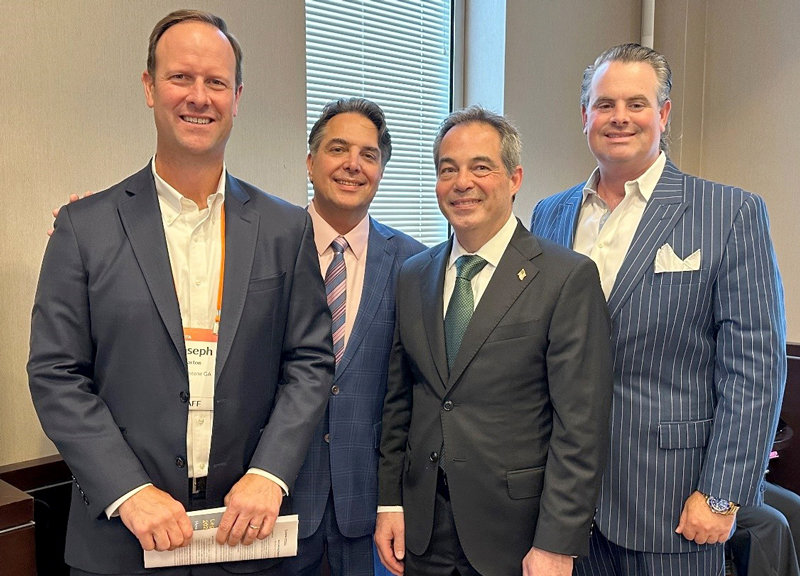
 L to R: Cornerstone Government Affairs Principal Joe Barton, Matt Daus, GBTA VP of Government and Community Relations Shane Downey, and RMA Worldwide VP Matt Assolin A Growing Partnership on Transportation Policy
One of the most encouraging takeaways from the Legislative Summit was the growing alignment between the GBTA and the NLA on many public policy issues. While GBTA’s advocacy has traditionally centered on aviation, border security, and the overall traveler experience, the event highlighted the increasing recognition that safe, efficient, and affordable ground transportation is essential to business travel.
NLA’s federal priorities complement those efforts by addressing many of the challenges business travelers encounter once they leave the airport. Among NLA’s top priorities are tackling the commercial transportation insurance affordability crisis through federal action, including support for the Staged Accident Fraud Prevention Act of 2025. NLA also supports expanding Sami’s Law by authorizing the U.S. DOT to develop enforceable passenger safety standards for for-hire transportation providers as well as guidance on No Tax on Tips and preserving Section 179.
Though these priorities address different aspects of business travel, they share a common goal: safe, efficient, and seamless travel as well as bipartisan policies that benefit both travelers and transportation providers.
Duty of Care Has Never Been More Important
Corporate duty of care extends well beyond confirming that a transportation provider is licensed, and I encouraged all travel managers to adopt a comprehensive due diligence process when selecting transportation providers. That includes verifying adequate insurance coverage, reviewing driver qualification and screening procedures, understanding vehicle inspection and maintenance programs, evaluating cybersecurity and data privacy protections, examining incident response protocols, and ensuring that contractual provisions appropriately allocate responsibility between the transportation provider and the client. Duty of care should also continue in the form of regular audits, performance monitoring, and ongoing compliance reviews.
 L to R: GBTA CEO Suzanne Neufang, Matt Daus, and Matt Assolin Emerging mobility technologies present tremendous opportunities to improve efficiency, sustainability, and accessibility, but they also introduce new operational models, evolving regulatory frameworks, and questions regarding insurance, cybersecurity, liability, and oversight. Companies embracing these technologies should maintain, if not strengthen, due diligence standards.
Turning Research Into Meaningful Insurance Reform
The commercial automobile insurance affordability crisis has been an issue for years, and it’s one that I have examined with the University Transportation Research Center (UTRC) at The City College of the City University of New York. I explained the findings of the report we collaborated on with the NLA, Curbing the Limousine Insurance Crisis: For-Hire Vehicle Insurance Reform.
The reports identify several interconnected factors contributing to the insurance crisis at the state and national levels. In New York, for example, expansive no-fault personal injury protection (PIP) requirements, increasing litigation costs, staged accidents, insurance fraud, nuclear verdicts, and a shrinking commercial insurance marketplace have combined to create an environment where insurers continue raising premiums while fewer companies remain willing to write commercial policies.
Among the recommendations are expanding access to alternative insurance markets, encouraging broader adoption of telematics and camera technologies, supporting industry-specific workers’ compensation models, and pursuing legal and regulatory reforms that better align insurance costs with actual operational risk while preserving strong consumer protections.
This industry has scored some important wins in New York City and Florida in recent years, but the work continues.
The forthcoming National Insurance Study for the U.S. Bus & Motorcoach Industry, done in conjunction with the American Bus Association Foundation and UTRC, will apply many of the same research methodologies of the NLA study.
Strengthening Enforcement to Protect Travelers and Legitimate Operators
Another report I authored with the UTRC, Addressing Unlicensed & Illegal Ride Hailing in the NY/NJ Metro Region, examines how illegal for-hire transportation has evolved into increasingly sophisticated operations that often mimic legitimate transportation businesses. For unsuspecting business travelers, the risks can be significant. Passengers may unknowingly enter vehicles without adequate insurance coverage, professionally vetted drivers, or meaningful consumer protections should something go wrong.
The report recommends stronger interagency coordination among transportation regulators, law enforcement, airports, and prosecutors; expanded use of technology to identify repeat offenders; improved public education campaigns; tougher penalties for chronic violators; enhanced reporting systems; and legislative reforms that better reflect the increasingly organized nature of illegal transportation networks.
These recommendations are also beginning to move into practice. The Port Authority of New York and New Jersey recently launched Operation Legal Ride, an initiative designed to combat illegal airport solicitation ahead of the 2026 FIFA World Cup and other major international events. Supported by a $100 million investment, the initiative combines expanded police deployments with advanced technology, including cameras, license plate readers, and AI to identify illegal operators before passengers are victimized.
The UTRC is currently preparing a nationwide enforcement study for the NLA examining illegal and unlicensed operations across the country. Our goal is to provide regulators and policymakers with practical recommendations to strengthen enforcement while protecting legitimate transportation providers and the traveling public.
Rethinking the Airport Experience
Ground transportation is an essential component of overall airport performance, and today’s airports face challenges involving curb congestion, limited passenger pickup and drop-off space, increasing rideshare activity, sustainability goals, accessibility requirements, and ever-growing passenger expectations.
I outlined several strategies including centralized ground transportation centers capable of accommodating taxis, limousines, transportation network companies, buses, shuttles, rental vehicles, and future autonomous services, along with more equitable curb management policies and technology that improves airport efficiency.
Autonomous Mobility and Beyond
I also encouraged attendees to begin preparing for what comes next, including the expanded AV deployment across the country. While a widespread rollout will occur gradually and regulatory frameworks will continue to evolve, autonomous mobility is steadily transitioning from pilot projects to commercial reality.
As these technologies mature, policymakers must ensure that innovation proceeds alongside appropriate safeguards. That is why the International Association of Transportation Regulators (IATR) created its Best Practices, Guiding Principles & Model Regulations for Robotaxis, which provides a framework addressing everything from insurance to data privacy.
Premium travelers will continue to expect safety, reliability, professionalism, and personalized service, regardless of whether their trip involves a traditional chauffeured sedan, an AV, or an air taxi. Technology may change the vehicle, but it does not eliminate the importance of customer service, operational excellence, or duty of care.
The chauffeured transportation industry can adapt and evolve alongside these technologies. Operators that embrace innovation, maintain high service standards, invest in technology, and remain engaged in the policymaking process will be best positioned to succeed as the transportation marketplace continues changing.
The Business Traveler of the Future
Every business trip begins and ends with ground transportation, which presents an important opportunity for organizations like GBTA.
While aviation policy remains central to business travel advocacy, other issues directly affecting travelers—insurance affordability, airport access, enforcement, regulatory modernization, and emerging mobility—deserve greater attention. I encouraged GBTA to deepen collaboration with organizations like the NLA, ABA, IATR, and other stakeholders to advance safety, affordability, and innovation in ground transportation.
Business travel is entering a transformative period. Meeting those challenges will require thoughtful regulation, evidence-based policymaking, effective enforcement, and continued collaboration among industry leaders, researchers, regulators, and policymakers. [CD0826]
Photos courtesy of Matt Daus
Lenore D’Anzieri is the CEO OF cognizant strategy management. She may be reached at
