

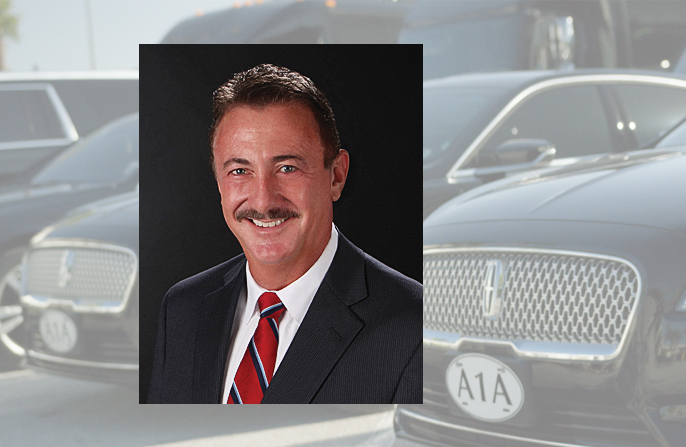
As the founder, president, and CEO of A1A Global Ground in South Florida, Rick Versace Sr. has certainly been on the forefront of chauffeured transportation going on four decades. A1A, a family-run business, has become one of the most respected names in the industry, known for their unconventional and trailblazing franchising business model. As an industry leader and devoted advocate, he serves as both the president of the Florida Limousine Association and as treasurer of the National Limousine Association. Among the many issues the organizations have tackled in recent months, soaring insurance rates and the uptick of illegal operators (which have surprising intersectionality) have been by far the most talked-about concerns.
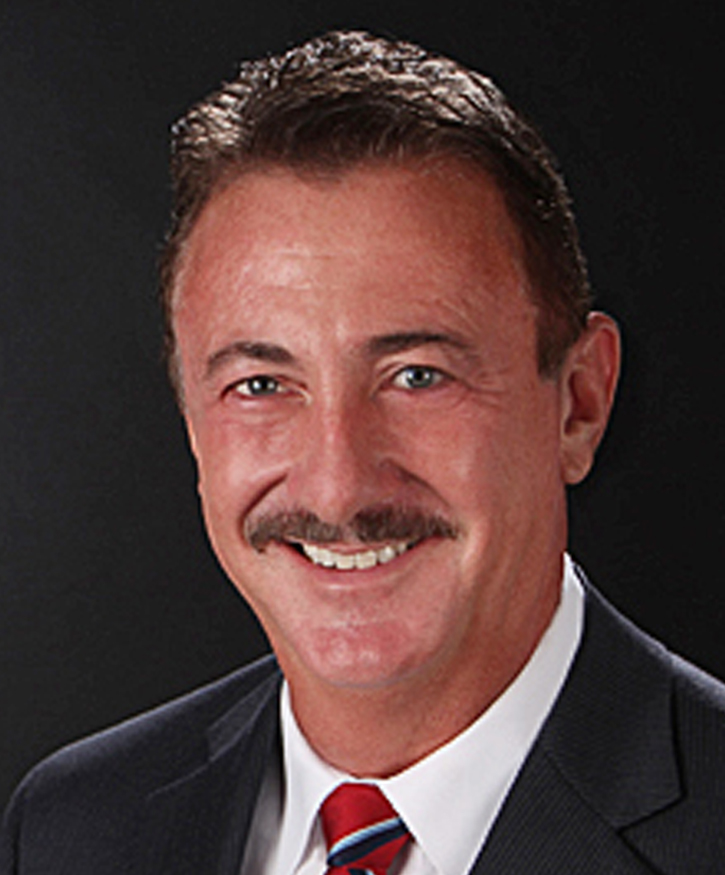 Rick Versace We spoke with him about a few of the major issues of the day, how he’s helping to drive awareness across the nation, and what he hopes to accomplish in the coming years, not only within his business but for the industry at large.
Chauffeur Driven: Insurance rates is the big topic. What’s happening in your state?
Rick Versace: In Florida, we began exploring ways to reduce insurance rates. We held meetings with agents, brokers, underwriters, and carriers to understand the challenges and identify how we could become true partners. We thought if we could help them control costs, we can control ours too.
During these discussions, the FLA created our Platinum Safety Program. This program requires companies to meet rigorous standards to earn Platinum Safety certification. That includes installing telematics in every vehicle, implementing driver training and coaching, conducting drug screenings, and more. It’s almost like forming a risk retention group for our association. Not everyone qualifies, but those who want to do it often do see significant benefits.
Interestingly, as we built this program, insurers began noticing that our industry was different—that we proactively prioritize safety far more than other transportation segments. Ultimately, we hope they’ll recognize that our industry deserves its own risk category, separate from taxis, TNCs, and other ground transportation.
CD: What impact has this had locally?
RV: When you focus on something and draw attention to it, change happens. We’ve already seen positive legislative reforms in Florida that made it easier for insurers to operate. New carriers entered the market, and some that had left are considering returning. More competition means lower premiums, right?
While rates elsewhere have climbed 20-40%, our rate increases in Florida have been closer to 5-10%. We’ve shared these successes with other associations during our Congress of Association Presidents monthly call and encouraged them to adopt similar strategies.
CD: The NLA just released a report on insurance called Curbing the Limousine Insurance Crisis. Why did you take this effort national?
RV: Matt Daus of Windels Marx approached us about severe insurance issues in New York—especially with an industry insurance company nearing bankruptcy. As an associate professor at the City University of New York (CUNY), researcher with the University Transportation Research Center, and president of the International Association of Transportation Regulators (IATR), he had already done some preliminary work. We proposed taking this effort national: a comprehensive research paper on the insurance industry. It’s affecting all of us.
The NLA Board approved the effort, so we invested heavily and secured federal grants to support the project. The study involved extensive surveys and research. When it was published, it made a huge impact—garnering countless views and attracting attention from regulators, underwriters, and insurance authorities. It highlighted that our industry represents a unique risk profile, with safety as the defining factor. I often say we’re the safest mode of transportation available today—and this proved it.
CD: You recently attended the IATR Conference this past September for the first time. What was that like?
RV: It was fascinating. I represented the NLA at the Nashville conference, which brings together regulators from across the US and around the world. It’s similar to our CD/NLA conventions—they share best practices, discuss technology, and explore regulatory strategies for everything from rickshaws to motorcoaches on a global level.
We unveiled the insurance report there, and it sparked intense interest. Regulators spent an entire afternoon discussing its implications; it was great to be able to have one-on-one conversations with them, to see their interest. Like our industry, they are concerned with the rise in illegal operators. The report revealed that skyrocketing insurance costs have driven many former legitimate operators underground because they can’t afford the increase. These aren’t just people soliciting rides in person at airports anymore—they’re using WhatsApp, Facebook groups, and their own websites. People are pre-booking with them online.
Shockingly, the estimate mentioned at the conference is that nearly 50% of ground transportation today may be handled by illegal operators!
CD: Matt Daus, through UTRC and in collaboration with the Chauffeured Transportation Association of New Jersey (CTANJ) and the Black Car Assistance Corporation (BCAC) recently released another study about illegal operators in the New York/New Jersey area. Is this also an issue in Florida?
RV: Absolutely. We’ve launched campaigns modeled after efforts in Long Island and New Jersey with the Long Island Limousine Association and CTANJ. For example, at Orlando International Airport, we worked with the airport administrator and secured seven Florida Highway Patrol officers dedicated to enforcement. They conduct sting operations by booking rides through social media and issuing citations upon arrival. Orlando alone has seen more than 300 citations since the program began. We’re expanding this to other airports statewide—we went to Palm Beach and had similar results, and we have something scheduled for Fort Lauderdale and Miami. Then we’ll go to Tampa and Naples. Even Uber and Lyft struggle with this. Drivers hand out business cards to bypass the apps, which often eliminates insurance coverage entirely. It’s a nightmare.
CD: What other issues are on your radar locally and nationally?
RV: Last year, we successfully changed Florida law to allow reciprocity for county licensing. Previously, operators needed separate permits for every county, which was costly and inefficient, not to mention the windows full of stickers. Now, if you’re licensed in one county, you can operate statewide.
However, airports were exempt from this legislation, so they began issuing their own permits and collecting fees. This year, we’re working with the Florida Airport Council and Florida Ports Council to create a common registry and payment system—similar to SunPass or E-ZPass—to make compliance seamless. Meanwhile, we’re also continuing campaigns against illegal operators and pushing public awareness that unlicensed rides are unsafe.
CD: Autonomous vehicles are becoming more ubiquitous. What are your thoughts on how it will shape the future of transportation?
RV: Autonomous vehicles are coming, and while it’s early, we need to prepare. I tested a Waymo in Phoenix and was impressed—it was safe, assertive, and even enforced seatbelt use. Uber and Lyft drivers there reported business down by 50%, but our segment hasn’t felt much impact yet because our clients expect a higher level of service.
The real game-changer will be Tesla’s AV technology, which can scale quickly. We need to explore how to integrate autonomous options into our fleets and adapt to this future.
Beyond AVs, technology in general is critical. Our industry has lagged behind because we lack the funding for advanced apps. With AI and automation, we need open APIs and better integration to streamline operations, marketing, and customer experience. The NLA has a technology committee to push these initiatives forward.
CD: What differentiates our industry and ensures our relevance?
RV: We’re in the hospitality business—hospitality on wheels. That’s our strength. We combine high-tech with high-touch, focusing on relationships and personalized service. You can’t build a relationship with an app, but you can with a trusted chauffeur or company. That’s what will keep us relevant.
CD: We saw an article recently that AV providers might consider putting “mobile concierges” in their vehicles. Isn’t that what our industry already does?
RV: I think they’re stealing a page from our playbook. And I think as the future comes, you’ll see a bigger convergence of the TNCs with our industry. You’re already starting to see it with Lyft’s acquisition of TBR. The lines are blurring, and who knows what the future is really going to bring.
CD: The age-old question is, how do we attract younger customers and talent?
RV: I see many young entrepreneurs entering the industry, which is great. The bigger challenge is attracting younger riders. PR plays a big role—showing that luxury transportation is accessible and stylish. Trends shift; years ago, limos were the norm, then SUVs became popular. We need to keep differentiating ourselves from TNCs and remain appealing to new generations.
CD: You’ve been a trailblazer for decades now. Where do you see A1A Global Ground in 10 years?
RV: Great question—and one I’m proud to answer. When I look 10 years down the road, I don’t just see a successful company, I see an industry platform. We’re intentionally building something bigger than any single operation or market. We are creating a nationwide—and ultimately global—franchise network of highly vetted, like-minded affiliate partners who share our standards for safety, service, technology, and accountability.
Our vision is simple but ambitious: two new A1A franchise locations every month. You do the math—that’s 24 new markets a year, over 200 markets in a decade. At that scale, A1A becomes the most trusted, consistent, and reliable premium ground transportation network in North America. But growth for us isn’t about logos on vehicles—it’s about infrastructure and trust. We’re building a franchise ecosystem where local operators keep their entrepreneurial independence while benefiting from shared technology, national sales, corporate accounts, and best-in-class standards. Most importantly, we’re building A1A the right way: by elevating professional operators, not replacing them. Our affiliates are our strength. Their success is our success.
Ten years from now, I believe A1A Global Ground will be viewed as a blueprint for how premium ground transportation should operate in a global, duty-of-care-driven travel environment: locally owned, nationally unified, and globally respected. And we’re already well on our way.
CD: Congratulations on your reelection to the NLA Board. What are you looking forward to in your next term?
RV: I’m most looking forward to helping the organization to serve our industry and members better. What I really enjoy about it, as a small company myself, is that we collectively can accomplish so much more than we can individually—and not just with legislation, advocacy, or PR, but just in general. Two heads are better than one, and we need each other to advance our industry. So, it’s not about individual companies and it’s not about a person. It’s more about us working together for the good of our entire industry so that future generations of transportation entrepreneurs can be successful and still be here. [CD1225]
