


BY SUSAN ROSE
Imagine it’s hours before the start of a week filled with major events. Reservations are stacked, you’ve secured extra chauffeurs and vehicles, and dispatch is preparing for some of the busiest few days of the year—a time that may bring in a quarter of this year’s revenue. Then, without warning, your team can no longer access the reservation system. Dispatch can’t communicate with chauffeurs. Accounting can’t access invoices. Customer records are encrypted, and a message appears demanding payment to restore your files.
That scenario is no longer far-fetched, and sadly, it’s becoming an all-too-common reality for businesses of every size, even on a slow Tuesday. More importantly, your business isn’t “too small” to be a target. Attackers exploit the fact that smaller businesses often have weaker defenses. If there’s a vulnerability in your system, you can be sure that they are going to find it.
Today’s attackers are sneakier than ever, relying on stolen identities, compromised cloud accounts, trusted software vendors, and increasingly sophisticated social engineering, which is manipulating or tricking people into giving away confidential information or access to secure systems. Artificial intelligence has accelerated that evolution, allowing criminals to produce convincing phishing emails, fake websites, and even voice impersonations that can fool experienced employees. In some cases, the attack started weeks or even months ago, slowly worming its way through your system until bam!—you’re in the middle of a full-blown ransomware attack. The consequences can be especially severe, especially considering the amount of sensitive information you manage.
 Two recently released reports paint a sobering picture of today’s cyber landscape for businesses. Lessons from the Front Lines: A Playbook for Outpacing Modern Adversaries, a recent report from CrowdStrike, examines how cybercriminals are changing their tactics, while the 2026 SMB Cybersecurity Statistics & Benchmark Report from SensCy measures how well small and midsized businesses (the “SMB” in the title) are prepared to defend themselves. Together, they deliver a clear message: Today’s attackers are moving faster than ever, and too many companies are still leaving the front door unlocked.
More concerning is that many operations remain unprepared for this reality. SensCy’s research, based on more than 500 cybersecurity assessments of SMBs, found that the greatest cybersecurity risk isn’t a lack of cutting-edge technology but the failure to consistently execute the basic practices that have long been known to reduce risk.
One of the biggest misconceptions about cybercrime is that hackers are breaking through firewalls with sophisticated tools, when in reality they’re often convincing someone inside the company to let them in. Whether it’s a dispatcher opening what appears to be an email from a coworker, a bookkeeper responding to what looks like an urgent payment request, or an employee unknowingly entering login credentials into a fraudulent website, attackers continue to exploit human nature as much as technology. And don’t assume the classic hallmarks of phishing emails—such as bad misspellings or unnatural language—are your dead giveaways because AI has made it much easier to produce savvy communication that doesn’t initially raise suspicion.
However, even if you have a cybersecurity plan, when is the last time you reviewed and updated it? Threats are constantly evolving, usually much faster than businesses think. According to the SensCy report, only 28 percent of business leaders receive regular cybersecurity briefings, fewer than one in four SMBs have formal cybersecurity policies and employee training processes, and half of the companies surveyed never conduct cybersecurity awareness training at all.
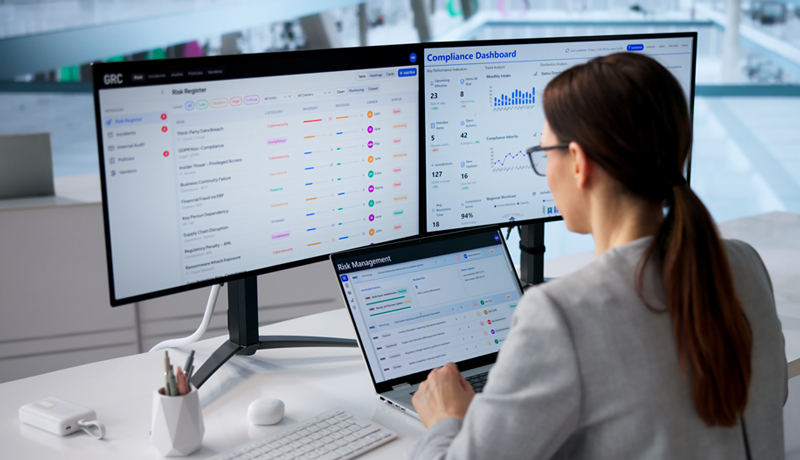 The encouraging news is that your team can become one of your strongest defenses. SensCy found that companies conducting regular cybersecurity awareness training and phishing simulations reduced employee click rates on phishing tests from an industry benchmark of 34 percent to roughly 10 percent, proving that cybersecurity doesn’t always require expensive software or an enterprise-sized IT budget.
The same philosophy applies to software maintenance. The CrowdStrike report notes that cybercriminals often begin exploiting newly disclosed software vulnerabilities within days of becoming public knowledge, while businesses are slower to react and install security patches (think: those annoying Microsoft updates that require several minutes to install and a restart). SensCy’s benchmarking data reinforces that concern as well. While businesses receive notifications when critical security patches become available, only one-third install them within 48 hours.
No legit company in our industry would postpone repairing faulty brakes or replacing worn tires simply because “it’s good enough.” At least, we hope. Yet many organizations treat software updates exactly that way, putting them off until there’s more time or waiting until a problem develops. Unfortunately, cybersecurity doesn’t work that way. The longer critical updates are delayed, the greater the opportunity for someone else to exploit them.
So where should operators begin? Both reports arrive at the same conclusion: Organizations don’t necessarily become more secure by spending more money; they become more secure by consistently executing the fundamentals.
#1 Make Cybersecurity a Leadership Discussion
Cybersecurity shouldn’t become a topic of conversation only after something goes wrong. Operators don’t need to become cybersecurity experts, but they should understand where their biggest risks lie, what safeguards are already in place, and who is responsible for monitoring them. A regular conversation, perhaps quarterly, with your IT provider about your company’s cyber posture can be just as valuable as reviewing your insurance coverage or financial statements.
Use dedicated accounts for your most sensitive operations like banking, and, with the help of your IT team, use automated tools wherever possible to scan for vulnerabilities or misconfigurations, according to CrowdStrike. Don’t neglect your website’s security either—Denial-of-Service (DoS) attacks are a thing, and if that’s your primary portal for reservations, it deserves your attention. Even so-called safeguards like a VPN or your fun AI platform can become a point of entry. CrowdStrike recommends using a Zero Trust model, which assumes no user or device should be trusted by default, from employees to remote workers to yes, even the owner. Instead, “continuous authentication, authorization, and validation of security configurations are required before access is granted to applications and data each time,” per the report. It requires an extra step, but it could mean the difference between secure and exposed.
#2 Turn Employees Into Your First Line of Defense
Criminals frequently trick employees into revealing credentials through convincing emails, text messages, or phone calls. Whether it’s clicking on a malicious attachment or responding to a convincing phishing email, human error remains one of the biggest contributors to successful cyberattacks. But don’t forget about suspicious phone calls—even those that sound real or plausible. Multi-factor authentication (MFA) is one of the simplest and most effective defenses available, and not just for the initial login as noted above. If your reservation platform, Microsoft account, payroll provider, banking portal, or accounting software supports MFA, enable it. Pair it with regular awareness training, which doesn’t need to be complicated or time-consuming but should be consistent. Teaching employees to slow down, verify unusual requests, and question anything that feels out of the ordinary can dramatically reduce risk. Always use common sense before opening that email attachment but also pay attention to the email address it’s coming from or replying to. Technology can block many attacks, but it can’t stop an employee from voluntarily inviting one in.
#3 Treat Software Updates Like Vehicle Maintenance
Our industry understands preventive maintenance. Vehicles receive routine service—and hopefully pre- and post-trip inspections—because small problems become expensive ones if they’re ignored. Software deserves the same mindset. CrowdStrike’s research shows that attackers often begin exploiting newly discovered vulnerabilities almost immediately after they’re disclosed, making delayed updates one of the easiest opportunities for cybercriminals to exploit. It’s worth repeating that critical security patches for industry software, operating systems, reservation platforms, firewalls, and other business applications should be installed as quickly as practical—not weeks or months later. Sophisticated hackers are using AI and bots to find those weak spots, and they don’t have to lift a finger to ruin your day.
#4 Know Who Has Access to Your Business
Every one of your virtual relationships—whether it’s industry software providers, payment processors, payroll companies, GPS vendors, website developers, third-party IT firms, and even the offsite person managing your social media—creates another potential access point into your business. CrowdStrike recommends reviewing who has administrator access to your systems, removing former employees immediately (and changing passwords when an employee leaves), and enabling MFA wherever it’s available. This is especially important for smaller businesses, where critical software and administrator credentials are often entrusted to a single person. If those credentials are stolen, misused, or intentionally abused, the consequences can extend far beyond a single compromised account, making access management one of the simplest and most effective security measures available.
#5 Prepare for the Day Something Goes Wrong
A smart operation has procedures for vehicle accidents, severe weather, and other operational disruptions. A cyberattack deserves the same level of preparation, including how your system is backed up—and more importantly, how it can be restored—beforehand. Yet SensCy found that fewer than one-third of small businesses have a formal incident response plan. Decide now who contacts your IT provider, bank, cyber insurance carrier (if you have one), and customers if systems become unavailable. Determine how your team will communicate if email is inaccessible and identify who has the authority to make critical decisions. Those conversations are far easier to have before a crisis than during one. Companies that recover fastest already have response plans and security controls in place before an attack occurs.
#6 Cybersecurity Is an Investment, Not an Expense
One of the most encouraging messages from both reports is that resilience doesn’t require perfection—or a massive budget. Strong passwords, MFA, employee training, prompt software updates, tested backups, and a written response plan won’t eliminate every risk, but together they make your business a much harder target. Cybercriminals often aren’t searching for the largest company. They’re searching for the easiest one.
When you boil it all down, cybersecurity isn’t just an IT issue anymore—it’s a business continuity issue. It’s about protecting reservations, safeguarding customer information, keeping chauffeurs on the road, and ensuring clients never know there was a problem in the first place. The businesses that will navigate the next wave of cyber threats most successfully won’t necessarily be the ones spending the most on technology—they’ll be the ones that recognize cybersecurity as another essential part of running a well-managed company. [CD0826]
